In short-term groundwater research, conventional PVC or HDPE monitoring wells are often left behind in the soil after use. The BioTube solves this: a biodegradable monitoring well that degrades naturally after use, without leaving behind any foreign material.
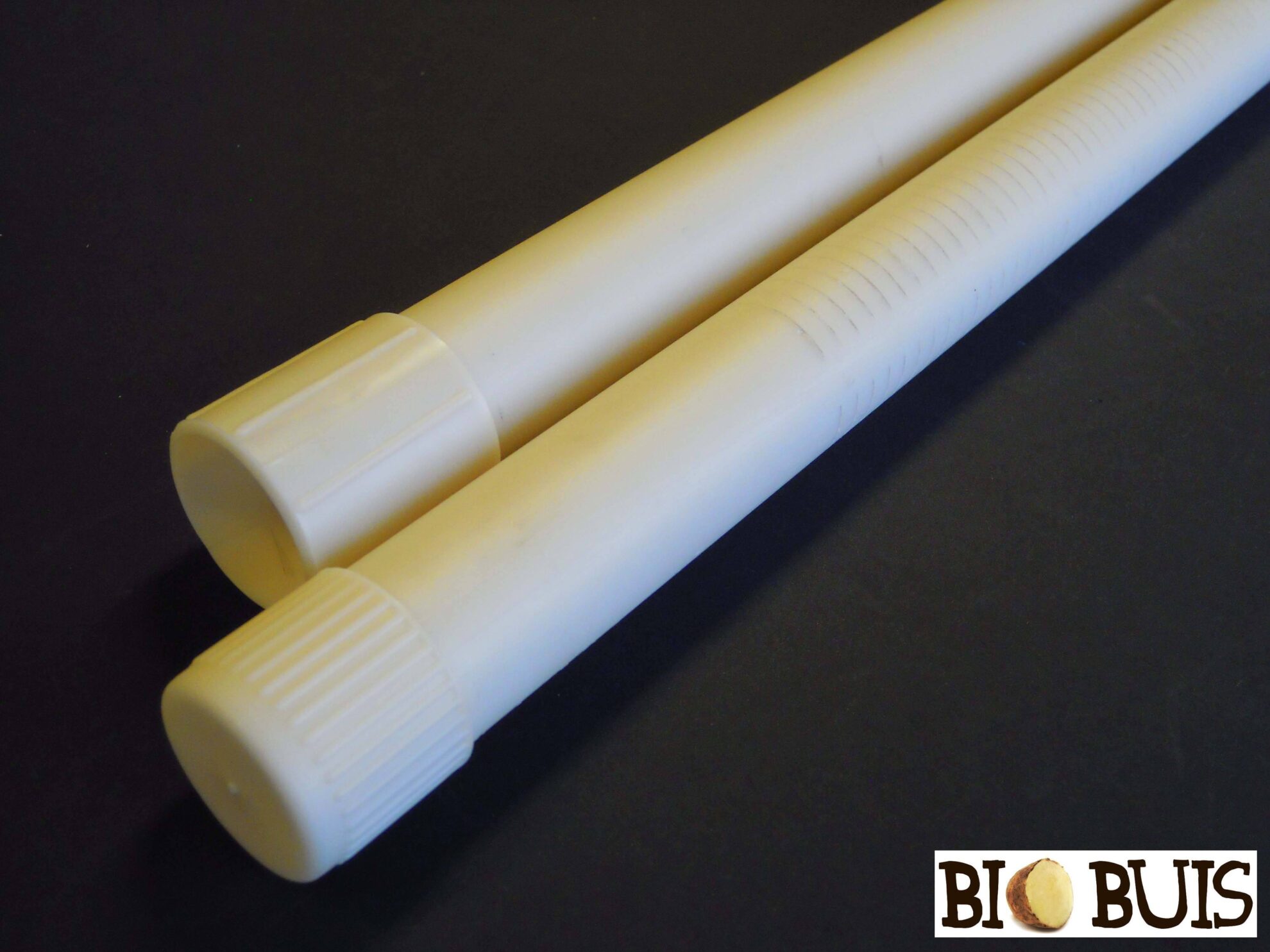
The BioTube is a monitoring well made of biodegradable Solanyl bioplastic, developed and produced by VRM. KIWA BRL K567 certified. After use, the pipe breaks down completely into water, CO2, and biomass. No PVC residue in the soil, no pollution. Solanyl is based on a by-product of the potato processing industry; no competition with the food chain.
Image: BioTube with the Solanyl material in view.
BRL-K561 en BRL-K567. Uw compliance is onze standaard
Van ontwerp tot opschaling in Apeldoorn. Maatwerk zonder omwegen.
Opgericht in 1906. Vakmanschap dat generaties meegaat.
| Feature | Value |
|---|---|
| Raw material | Solanyl bioplastic (potato processing by-product) |
| Certification | KIWA BRL K567 |
| Diameter | Ø33 mm |
| Filter (L) | 1 meter |
| Riser pipe (L) | 2 meters |
| Service life in soil | Minimum 1 year (KIWA standard) |
| Recommended sampling period | Within 1 year after installation |
| Degradation product | Water, CO2, and biomass |
| Packaging | Individually wrapped in biodegradable film |
Accessories: compression couplings and caps made of the same Solanyl material; clay rod and clay seal (Minikolit) for sealing the borehole after installation.
Sealing with Minikolit: after the sampling period, the BioBuis is filled with KIWA-certified swelling clay (clay rod or clay seal from Minikolit, available from VRM). The clay swells and seals the borehole, preventing groundwater flow between soil layers. This complies with the requirements of the Soil Protection Act.
Articles:
| Article code | Description | Packaging |
|---|---|---|
| 390133 | BioBuis filter 33×2.5 L=1m, perforated, KIWA K567 | Box of 30 pieces, individually wrapped |
| 392033 | BioBuis riser pipe 33×2.5 L=2m, KIWA K567 | Box of 30 pieces, individually wrapped |
| 399001 | BioBuis cap 33, KIWA K567 | Bag of 30 pieces |
| 399002 | BioBuis compression coupling 33, KIWA K567 | Bag of 30 pieces |
No. Use only the corresponding BioBuis items, otherwise the benefit of full biodegradability will be lost.
Yes. The BioBuis does not adversely affect the soil sample and therefore meets this requirement.
The technical lifespan is 1 year from the date of installation. Preferably take samples within a maximum of 3 months after installation.
That depends on the borehole diameter, the filter gravel, and the application. Please check the dimensions on the product page or contact us for tailored advice.
For one-off exploratory research (NEN 5740), standard PVC monitoring wells with threaded connections without glue are approved in accordance with the PFAS Sampling Guidelines. For long-term monitoring, virgin HDPE is recommended. Pump hoses must always be made of HDPE or silicone: no LDPE, no Teflon.
Yes. VRM monitoring wells and filter products comply with the material and installation requirements of BRL SIKB 2000 Protocol 2001 and 2002.
PVC is the standard for most dewatering applications. HDPE is preferred in cases of aromatic contamination or chemically harsher soil conditions. VRM provides advice based on your specific situation.
Yes. The LevelLog communicates via LTE-M and is directly accessible through the VRM LevelLog web portal. Multiple loggers can be managed within a network, featuring interactive map displays, alerts, and data export. No calibration or tools are required for installation.
In accordance with the KIWA BRL K567 standard, the BioBuis has a lifespan of at least 1 year after installation. VRM recommends completing the sampling period within that year. After use, the borehole is sealed with Mikolit clay pellets or clay seals, available from VRM.
VRM is certified for KIWA BRL-K561 (monitoring wells and fittings for drinking water and groundwater monitoring), KIWA BRL K567 (BioPipe), ISO 9001 (quality management), and PSO Step 3 and 30+ (social entrepreneurship). Certificates are available for download on the quality page.
NEN 6693 is the new standard for soil descriptions in boreholes and monitoring wells, replacing NEN 5104 and NEN 5706. The standard is leading within the BRO (Key Registry for the Subsurface) and environmental soil research. VRM documentation aligns with NEN 6693.
Yes. VRM produces in-house in Apeldoorn. Customisation in diameter, length, and perforation is possible for well screens, piezometers, infiltration pipes, and plastic components. From single items to larger series. Request a quote via the contact form.
No. Use only the corresponding BioBuis items, otherwise the benefit of full biodegradability will be lost.
Yes. The BioBuis does not adversely affect the soil sample and therefore meets this requirement.
The technical lifespan is 1 year from the date of installation. Preferably take samples within a maximum of 3 months after installation.
That depends on the borehole diameter, the filter gravel, and the application. Please check the dimensions on the product page or contact us for tailored advice.
For one-off exploratory research (NEN 5740), standard PVC monitoring wells with threaded connections without glue are approved in accordance with the PFAS Sampling Guidelines. For long-term monitoring, virgin HDPE is recommended. Pump hoses must always be made of HDPE or silicone: no LDPE, no Teflon.
Yes. VRM monitoring wells and filter products comply with the material and installation requirements of BRL SIKB 2000 Protocol 2001 and 2002.
PVC is the standard for most dewatering applications. HDPE is preferred in cases of aromatic contamination or chemically harsher soil conditions. VRM provides advice based on your specific situation.
Yes. The LevelLog communicates via LTE-M and is directly accessible through the VRM LevelLog web portal. Multiple loggers can be managed within a network, featuring interactive map displays, alerts, and data export. No calibration or tools are required for installation.
In accordance with the KIWA BRL K567 standard, the BioBuis has a lifespan of at least 1 year after installation. VRM recommends completing the sampling period within that year. After use, the borehole is sealed with Mikolit clay pellets or clay seals, available from VRM.
VRM is certified for KIWA BRL-K561 (monitoring wells and fittings for drinking water and groundwater monitoring), KIWA BRL K567 (BioPipe), ISO 9001 (quality management), and PSO Step 3 and 30+ (social entrepreneurship). Certificates are available for download on the quality page.
NEN 6693 is the new standard for soil descriptions in boreholes and monitoring wells, replacing NEN 5104 and NEN 5706. The standard is leading within the BRO (Key Registry for the Subsurface) and environmental soil research. VRM documentation aligns with NEN 6693.
Yes. VRM produces in-house in Apeldoorn. Customisation in diameter, length, and perforation is possible for well screens, piezometers, infiltration pipes, and plastic components. From single items to larger series. Request a quote via the contact form.